
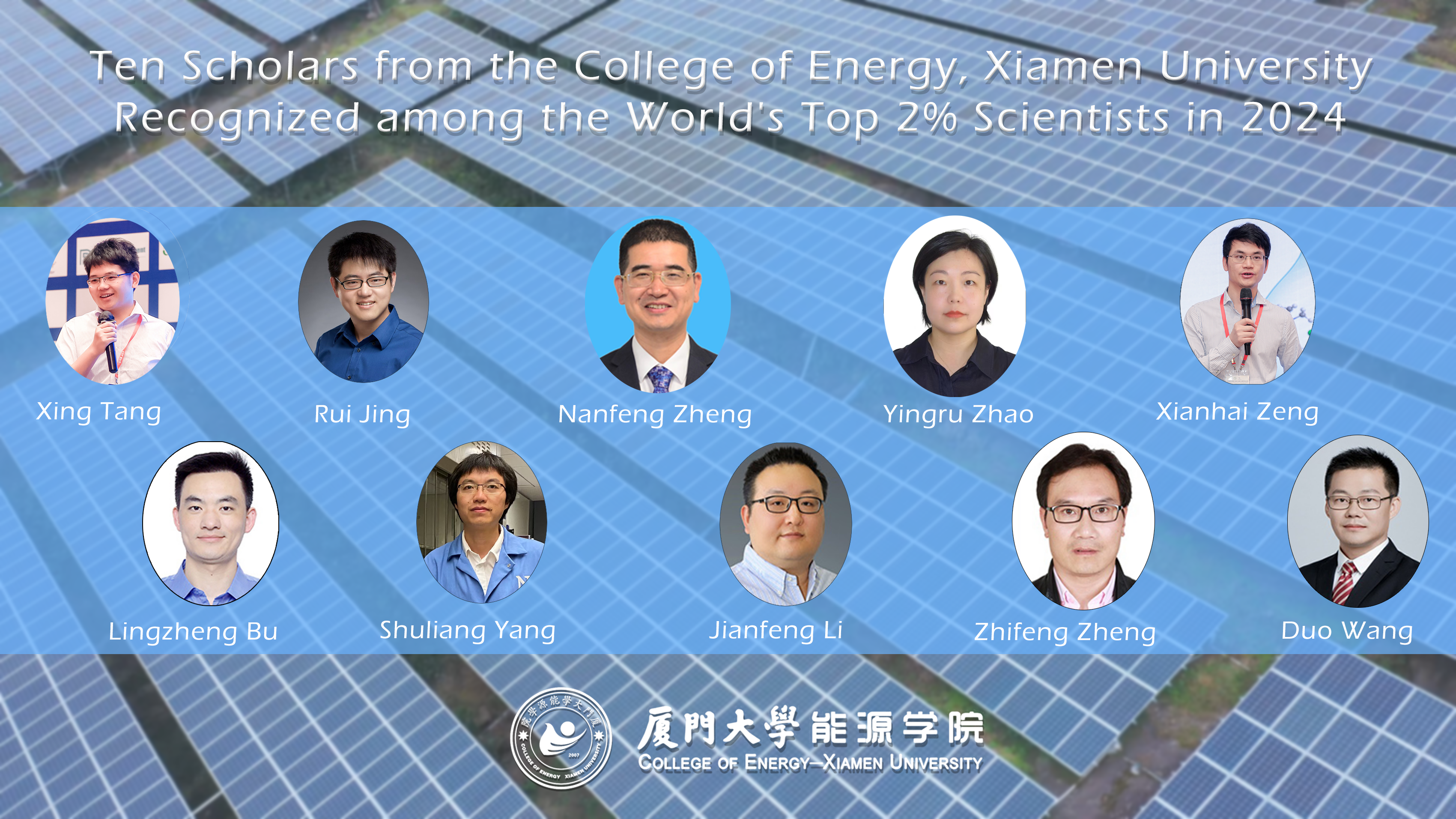
An important progress has been made by the research team led by Xianhai Zeng of our college in the field of biomass catalytic conversion
Date: January 9, 2026
Linear alcohols serve as critical raw materials for the preparation of polymers and synthetic solvents. The conventional production process of 2,5-hexanediol (2,5-HDL) suffers from drawbacks such as complex process flows. The catalytic conversion of bio-based platform molecules represented by 5-hydroxymethylfurfural (HMF) into linear alcohols has emerged as a promising alternative approach; nevertheless, it is plagued by excessive by-product formation and low product yield.
Recently, the research team led by Professor Xianhai Zeng from our college developed a RuCo/SBA-15 bimetallic catalyst, which enables the complete conversion of furanic molecules into linear alcohols with a yield exceeding 80%, exhibiting superior performance to most analogous catalysts. Combining experimental characterization, in-situ infrared spectroscopy, density functional theory (DFT) calculations and kinetic simulations, the research team directly confirmed for the first time that cobalt and ruthenium display distinct adsorption behaviors toward furanic compounds. By virtue of such adsorption differences, tandem catalysis is realized to convert furanic compounds into linear alcohols. This study proposes an innovative green catalytic strategy, provides technical support for the large-scale and efficient production of linear alcohols, and is expected to advance the industrialization process of converting biomass-derived compounds into high-value-added chemicals.
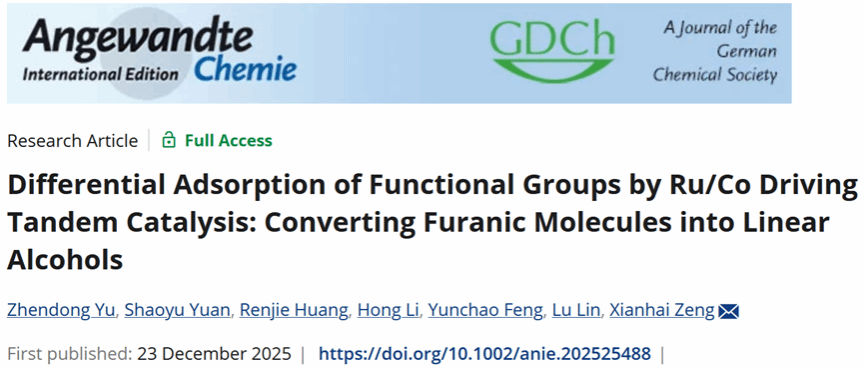
This work entitled Differential Adsorption of Functional Groups by Ru/Co Driving Tandem Catalysis: Converting Furanic Molecules into Linear Alcohols has been published online in Angew. Chem. Int. Ed. (2025, e25488) and has been rated as a Very Important Paper (VIP). Zhendong Yu, a PhD student of the 2022 intake in our college, is the first author of this paper, and Professor Xianhai Zeng from our college is the sole corresponding author. This study was supported by the National Key Research and Development Program of China (2021YFC2101604), the National Natural Science Foundation of China (U23A20123, 22278339), the Major Special Project of Fujian Province (2022YZ037013), and other research funding projects.
Paper link: https://doi.org/10.1002/anie.202525488
Recommended
-

Students and Teachers of Our College Won Several Prizes in 2018 Science Innovation Competitions
-

Xiangshan College Held the Lantern Festival Party for the 98th Anniversary Celebration
-

Our college’s exchange meeting for the sharing of experience of undergraduate graduates in 2019 was held successfully
-

Enrollment propaganda in 2019 winter vacation of college of energy ended with a great success
-

The safety education conference for students in the winter vacation in 2018-2019 school year was held in our college