
Research Progress from Dr. Yao Zhou’s group: Development of Alkaline Hydrogen Oxidation Electrocatalyst
Date: August 25, 2025
The development of high-performance hydrogen fuel cells relies on highly active and stable cathode and anode electrocatalysts. For alkaline fuel cells, the kinetics of the hydrogen oxidation reaction (HOR) on platinum-based catalysts are extremely sluggish. Recent studies have indicated that a key reason for the slow alkaline HOR kinetics is the unsynchronized transfer of electrons and protons: the protons generated during the HOR on the Pt surface cannot be efficiently transported into the bulk solution, leading to a decoupling of electron and proton transfer.
Recently, studies from Dr. Yao Zhou and Prof. Jun-Tao Li’s group reported that, by anchoring a mild proton acid on a conductive carbon support, the corresponding conjugate base can undergo protonation–deprotonation repetitively, which can facilitate proton transportation away from the Pt surface during the alkaline HOR. Taking phosphate groups anchored on the carbon surface as an example, during the HOR, they can capture the proton around the Pt surface (Pt-H+ + C-PO42- → Pt + C-H2PO4), which is then rapidly neutralized by OH- in the bulk solution (C-H2PO4 + OH- → C-PO42- + H2O), thereby completing proton transfer from the Pt surface and significantly enhancing the HOR kinetics.
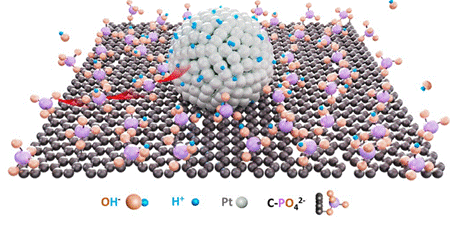
More details of this work, which is titled “Conjugated Base Assists Proton Stripping off Pt for Alkaline H2 Electrooxidation,” can be found in Angew. Chem. Int. Ed, 2025,64(32), e202513621.
The research was supported by the National Key Research and Development Program of China (2021YFA1502000), the National Natural Science Foundation of China (22472142), and the Fujian Provincial Natural Science Foundation for Outstanding Young Scholars (2024J09010).
Link to the full text: https://onlinelibrary.wiley.com/doi/10.1002/anie.202513621
Recommended
-

Students and Teachers of Our College Won Several Prizes in 2018 Science Innovation Competitions
-

Xiangshan College Held the Lantern Festival Party for the 98th Anniversary Celebration
-

Our college’s exchange meeting for the sharing of experience of undergraduate graduates in 2019 was held successfully
-

Enrollment propaganda in 2019 winter vacation of college of energy ended with a great success
-

The safety education conference for students in the winter vacation in 2018-2019 school year was held in our college