
Professor Zhifeng Zheng's Team from the Department of Energy Storage Makes New Progress in Dual-Carbon Sodium-Ion Capacitors
Date: September 4, 2025
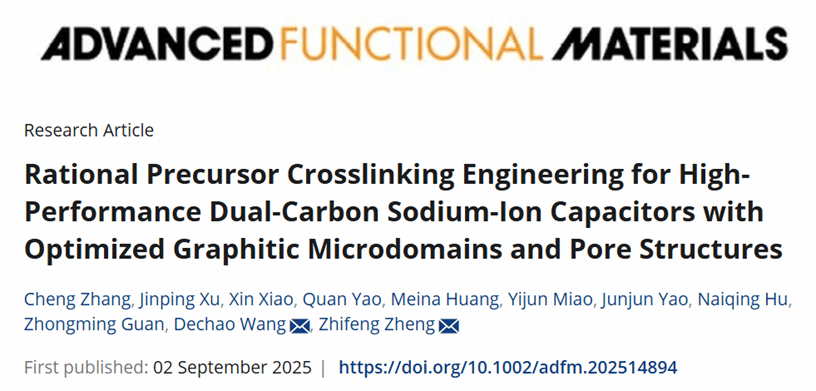
Recently, the team led by Assistant Professor Dechao Wang and Professor Zhifeng Zheng from the Department of Energy Storage of our college has proposed an innovative "Precursor Crosslinking Engineering" strategy. Using a single phenol-furfural resin as the precursor, they successfully synthesized an optimized hard carbon anode and a porous carbon cathode simultaneously by precisely regulating the crosslinking degree. The constructed dual-carbon sodium-ion capacitors (SICs) exhibit excellent energy density, power density, and wide-temperature stability. The related research results, titled Rational Precursor Crosslinking Engineering for High-Performance Dual-Carbon Sodium-Ion Capacitors with Optimized Graphitic Microdomains and Pore Structures, have been published in Advanced Functional Materials, providing a new path for the industrial application of low-cost and high-stability sodium-ion energy storage devices.
Sodium-ion capacitors (SICs) are regarded as an important candidate technology for next-generation large-scale energy storage due to the abundant reserves and low cost of sodium resources. The research and development of traditional dual-carbon SICs have long faced a long-standing bottleneck: it is difficult to simultaneously optimize the core performances of the anode (sodium storage capacity and kinetics) and the cathode (ion adsorption and cycling stability) from a single precursor. In addition, the commonly used phenolic resin precursor relies on formaldehyde, which poses environmental risks.
To address this issue, based on the concept of green chemistry, the team selected furfural to replace formaldehyde for the synthesis of phenol-furfural resin and designed a "one-pot" polymerization process. Precursors with different crosslinking degrees were prepared by adjusting the resin crosslinking time. After high-temperature carbonization, the high-crosslinking-degree precursor forms a hard carbon anode (24H1400) with "expanded interlayer spacing of graphitic microdomains (0.392 nm) + high closed micropore volume", which effectively solves the problems of slow sodium ion intercalation kinetics and low capacity. After carbonization and activation, the medium-crosslinking-degree precursor constructs a porous carbon cathode (A15H750) with "high microporosity (49.47%) + abundant oxygen-containing functional groups", which significantly improves the ion adsorption capacity and cycling stability.
The hard carbon anode prepared from the high-crosslinking-degree precursor delivers a reversible capacity of 337.8 mAh/g at a current density of 0.05 A/g with an initial Coulombic efficiency of 87.9%, and retains a capacity of 134.0 mAh/g at a high rate of 2 A/g. The porous carbon cathode A15H750 obtained from the medium-crosslinking-degree precursor via carbonization and activation has a microporosity of 49.47% and an oxygen-containing functional group content of 7.47%. It achieves a capacity of 206.5 mAh/g at 0.1 A/g and a capacity retention rate of nearly 100% after 10,000 cycles at 10 A/g. The assembled sodium-ion capacitor realizes a maximum energy density of 160.2 Wh kg⁻¹ and a maximum power density of 12720.8 W kg⁻¹.
Cheng Zhang, a 2023-entry master's student of our college, is the first author. Assistant Professor Dechao Wang and Professor Zhifeng Zheng are the co-corresponding authors. This work was supported by the Fujian Provincial Science and Technology Program (2022G02020, 2022H6002), the Platform Project of Fuzhou-Xiamen-Quanzhou National Independent Innovation Demonstration Zone (3502ZCQXT2022001), and the Xiamen Major Science and Technology Project (3502Z20231058).
Paper link: https://advanced.onlinelibrary.wiley.com/doi/epdf/10.1002/adfm.202514894
Recommended
-

Students and Teachers of Our College Won Several Prizes in 2018 Science Innovation Competitions
-

Xiangshan College Held the Lantern Festival Party for the 98th Anniversary Celebration
-

Our college’s exchange meeting for the sharing of experience of undergraduate graduates in 2019 was held successfully
-

Enrollment propaganda in 2019 winter vacation of college of energy ended with a great success
-

The safety education conference for students in the winter vacation in 2018-2019 school year was held in our college