
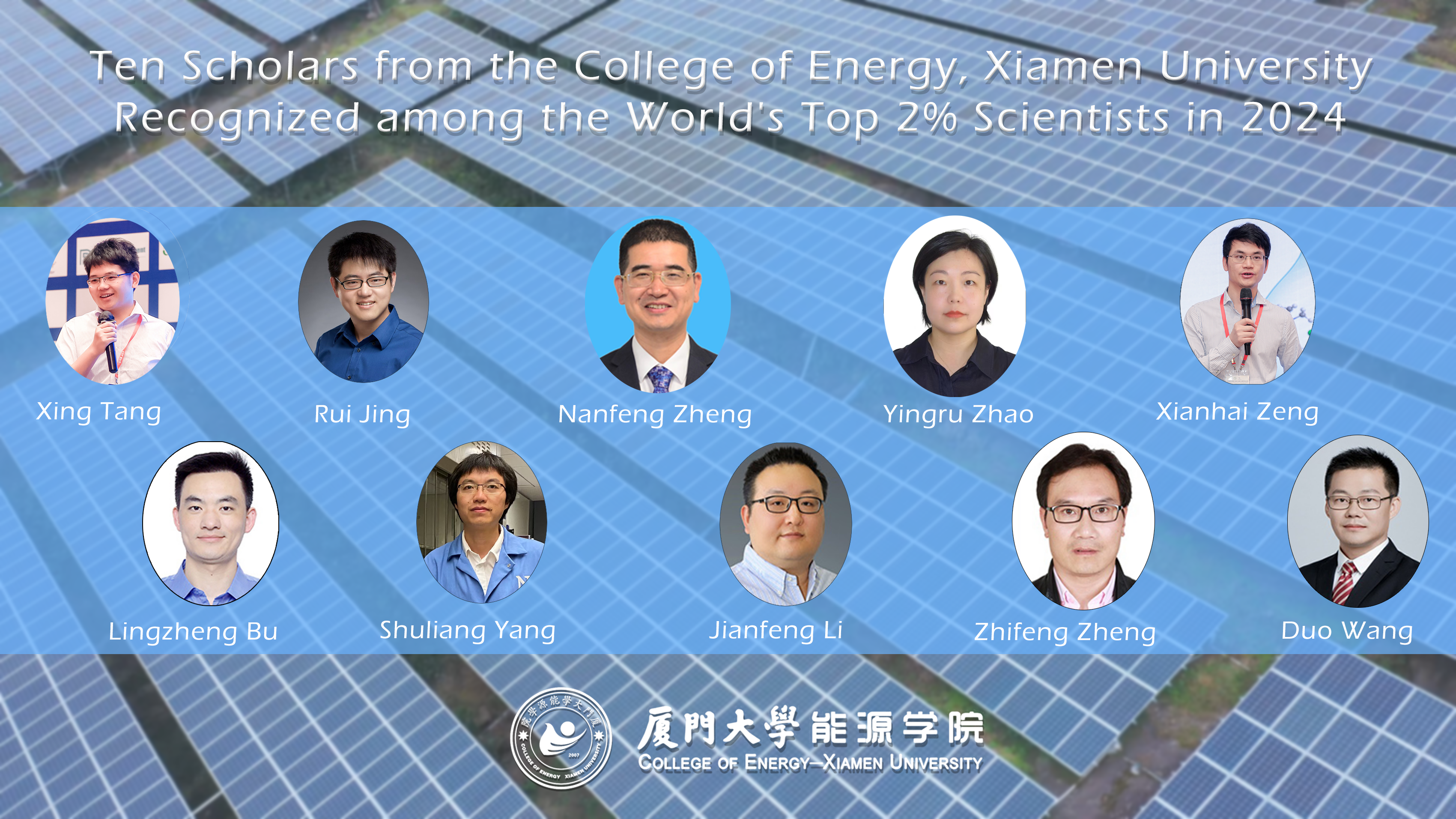
Prof. Shuliang Yang’s Group Achieves Significant Progress in the In Situ Encapsulation of [2]Catenane Molecules
Date: August 25, 2025
As an emerging class of porous materials, metal–organic frameworks (MOFs) are capable of accommodating a wide range of guest molecules, thereby enabling diverse applications. Among the various strategies for introducing guests, the in situ encapsulation approach offers unique advantages, as it allows the incorporation of small molecules, organometallic clusters, proteins, and even more complex species directly into the framework. Previous studies have primarily focused on the encapsulation of neutral or anionic guests; however, the in situ encapsulation of cationic mechanically interlocked molecules within MOFs under mild conditions remains rarely explored.
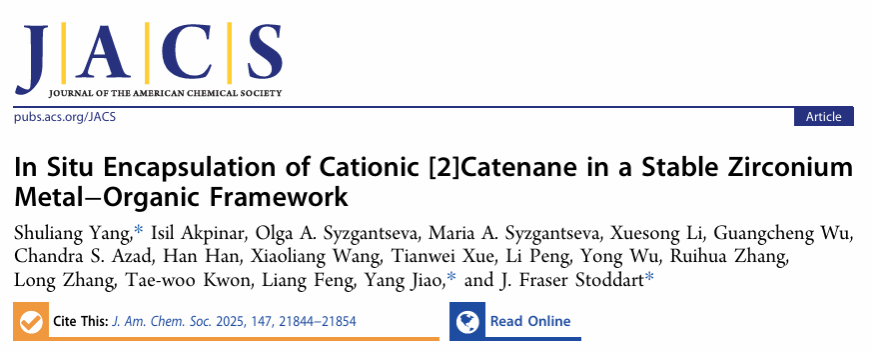
Recently, Prof. Shuliang Yang from our college, in collaboration with Prof. Yang Jiao from Peking University and the team of Prof. J. Fraser Stoddart at Northwestern University, reported a green in situ encapsulation strategy. Under ambient conditions and using water as a green solvent, a cationic [2]catenane (DA[2]C) was successfully encapsulated in situ within the UiO-66-F4 MOF. This framework is constructed from Zr6 nodes and tetrafluoroterephthalic acid linkers. The presence of DA[2]C·4Cl within the framework was confirmed by FTIR, solid-state NMR (ssNMR), and XPS analyses. Theoretical calculations reveal strong interactions between the tetrafluoroterephthalate ligands and the cationic DA[2]C, primarily arising from electrostatic interactions between the carboxylate anions and the cationic species, as well as the attraction exerted by the highly electronegative fluorine atoms.
As a proof-of-concept application, the DA[2]C·4Cl/UiO-66-F4 composite exhibits excellent performance in catalytic detoxification reactions. It achieves complete transformation of 2-chloroethyl ethyl sulfide into the corresponding sulfoxide with exceptionally high selectivity (>97%). Moreover, this strategy can be extended to other organic cationic molecules, including dibenzylbenzimidazolium chloride and functionalized polycyclic aromatic hydrocarbons, providing a general platform for constructing host–guest MOF systems with broad application potential.
This work, entitled “In Situ Encapsulation of Cationic [2]Catenane in a Stable Zirconium Metal-Organic Framework” has been published in Journal of the American Chemical Society.
Prof. Shuliang Yang is the first author and co-corresponding author of the paper. This research was supported by the National Natural Science Foundation of China (22471008, 22373080), the Fujian Provincial Natural Science Foundation (2022J05009), the Fundamental Research Funds for the Central Universities (20720240054), as well as the Nanqiang Young Scholar Program of Xiamen University and the Xiaomi Young Talent Program / Xiaomi Foundation.
For more details, please refer to the original publication:
https://pubs.acs.org/doi/abs/10.1021/jacs.5c04895
Recommended
-

Students and Teachers of Our College Won Several Prizes in 2018 Science Innovation Competitions
-

Xiangshan College Held the Lantern Festival Party for the 98th Anniversary Celebration
-

Our college’s exchange meeting for the sharing of experience of undergraduate graduates in 2019 was held successfully
-

Enrollment propaganda in 2019 winter vacation of college of energy ended with a great success
-

The safety education conference for students in the winter vacation in 2018-2019 school year was held in our college