
Natural Wood “Transformed” into a Highly Efficient Catalyst: Breakthrough in Paired Electrocatalysis by the Teams of Prof. Shuliang Yang and Prof. Jian-Feng Li
Date: May 19, 2026
Driven by the “dual carbon” goals and the principles of green chemistry, constructing efficient electrochemical systems based on renewable biomass resources to enable the synergistic production of value-added chemicals has become a key research direction in energy and materials science. However, achieving efficient coupling of oxidation and reduction reactions within a single electrolytic system imposes stringent requirements on the structural design of electrode materials and interfacial regulation.
Recently, the teams of Prof. Shuliang Yang and Dr. Jia Yu, in collaboration with Prof. Shisheng Zheng and Prof. Jian-Feng Li from our college, have made significant progress in the development of natural wood-derived porous carbon-based electrodes for paired electrocatalysis. Their work, entitled “Interface-Engineered NiCo Sites on Natural Wood-Derived Porous Carbon Substrate for Efficient Paired Electrocatalysis” has been published in Science China Materials and selected as a front cover article.
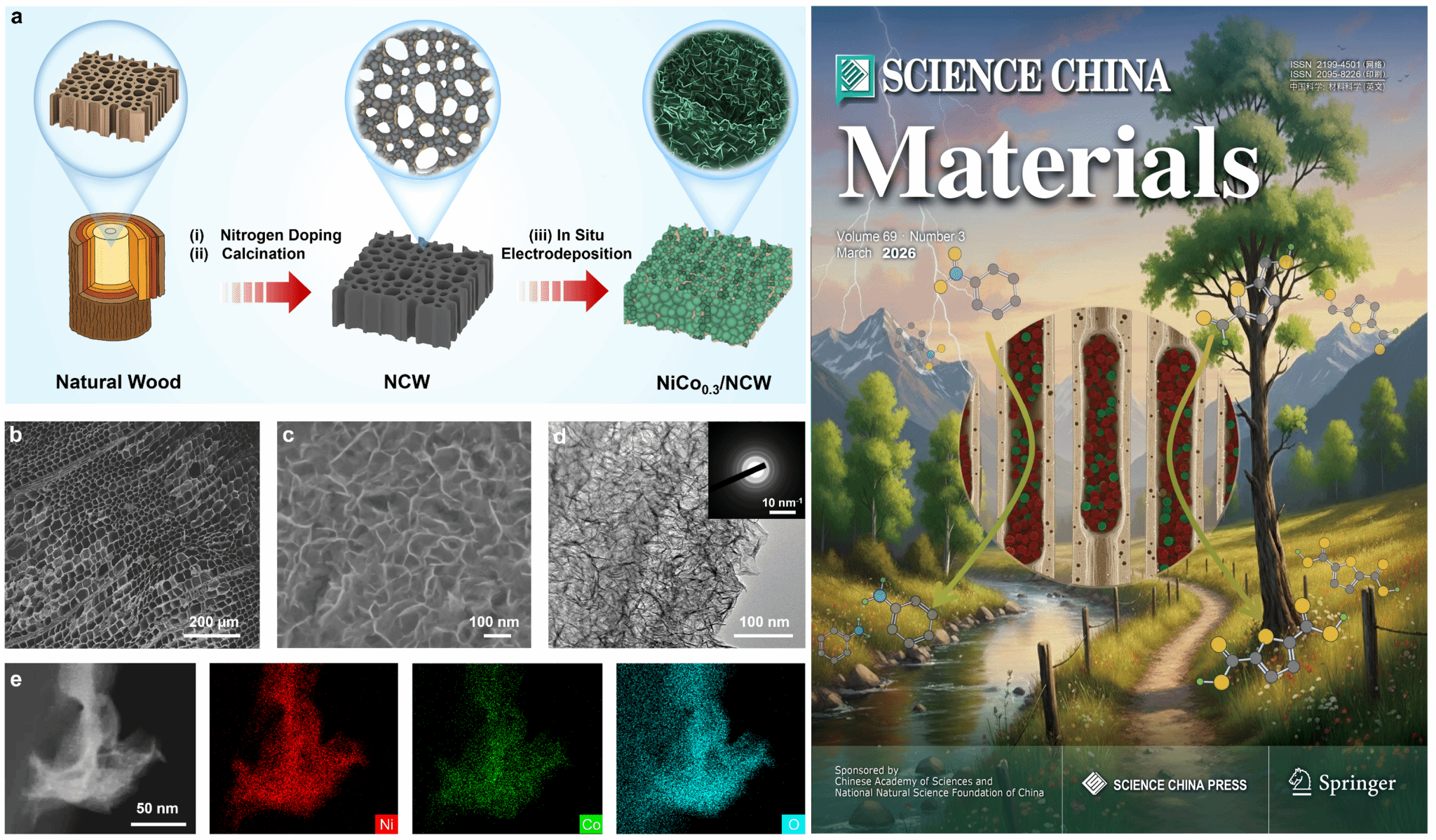
In this study, natural pine wood was employed as a precursor to construct a three-dimensional conductive framework via nitrogen-doped carbonization, while preserving its intrinsic hierarchical porous architecture. Subsequently, NiCo bimetallic nanosheets were in situ electrodeposited onto the framework, yielding a self-supported bifunctional electrode. Benefiting from the continuous mass transport channels inherent to wood, the enhanced metal–support interactions induced by nitrogen doping, and the precise electronic modulation of Ni by Co, the electrode enables the simultaneous realization of highly selective oxidation of the biomass-derived platform molecule 5-hydroxymethylfurfural (HMF) to 2,5-furandicarboxylic acid (FDCA) at the anode, and highly selective reduction of nitrobenzene to aniline at the cathode within the same electrolytic system.
In a two-electrode configuration, this paired electrocatalytic system requires only a cell voltage of 1.7 V to simultaneously achieve a Faradaic efficiency of ~99% for FDCA at the anode and ~92% for aniline at the cathode, significantly outperforming conventional systems coupled with the hydrogen evolution reaction. In situ Raman spectroscopy, electron paramagnetic resonance (EPR), and density functional theory (DFT) calculations reveal that the introduction of Co effectively stabilizes high-valent Ni3+ active species, optimizes the adsorption of reaction intermediates, and significantly lowers key reaction energy barriers, thereby enabling efficient and stable bidirectional catalytic synergy.
This work highlights the unique advantages of natural wood-derived structures in constructing high-performance self-supported electrodes, offering new insights into material design and mechanistic understanding for the deep coupling of biomass upgrading and organic electrosynthesis. It also provides valuable guidance for advancing green chemistry and sustainable electrochemical manufacturing.
Junhua Kuang, a 2024 Ph.D. student from our college, is the first author of this paper. Undergraduate students Hangyong Ye, Zifan Li, and Ziyan Wang also made important contributions. Prof. Shuliang Yang, Dr. Jia Yu, Prof. Shisheng Zheng, and Prof. Jian-Feng Li are the corresponding authors.
This work was supported by the National Natural Science Foundation of China (T2293692, 22525042, 22021001, and 22373080), the Natural Science Foundation of Fujian Province (2025J08010), the Natural Science Foundation of Xiamen (3502Z202471009 and 3502Z202472001), the Fundamental Research Funds for the Central Universities (20720240054), as well as the Nanqiang Young Scholars Program of Xiamen University and the Xiaomi Young Talent Program/Xiaomi Foundation.
Full text: https://link.springer.com/article/10.1007/s40843-025-3815-0
Recommended
-

Students and Teachers of Our College Won Several Prizes in 2018 Science Innovation Competitions
-

Xiangshan College Held the Lantern Festival Party for the 98th Anniversary Celebration
-

Our college’s exchange meeting for the sharing of experience of undergraduate graduates in 2019 was held successfully
-

Enrollment propaganda in 2019 winter vacation of college of energy ended with a great success
-

The safety education conference for students in the winter vacation in 2018-2019 school year was held in our college