
New Progress in Quantitative Analysis of Calendar Aging in Lithium-Ion Batteries by the Research Team of Professors Yong Yang and Zhengliang Gong
Date: January 29, 2026
Quantitative elucidation of calendar aging mechanisms is crucial for the development of long-life lithium-ion batteries suitable for large-scale energy storage systems and electric vehicles. In recent years, studies on the calendar aging behavior and mechanisms of lithium-ion batteries under high-temperature storage conditions have generally suggested that elevated temperatures accelerate side reactions, thereby promoting the growth of the solid electrolyte interphase (SEI). However, due to limitations in quantitative characterization techniques, the formation and structural evolution of the SEI at different storage temperatures have not yet been fully clarified.
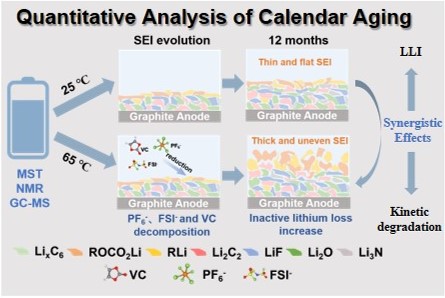
Recently, the research team of Professors Yong Yang and Zhengliang Gong at Xiamen University employed a combination of mass spectrometry titration (MST), nuclear magnetic resonance (NMR), and gas chromatography–mass spectrometry (GC–MS) to investigate the correlation between calendar aging behavior and temperature in LiFePO4/graphite batteries. This work provides an in-depth analysis of the calendar aging mechanisms of lithium-ion batteries under different storage temperatures. The study, entitled “Calendar Aging of LiFePO4/Graphite Batteries: Quantitative Analysis of Synergistic Effects of SEI Evolution and Electrolyte Decomposition,” was published in the journal ACS Energy Letters.
The results reveal a synergistic degradation mechanism involving SEI evolution and electrolyte decomposition during calendar aging. Loss of lithium inventory (LLI) is identified as the dominant degradation pathway. Elevated storage temperatures significantly accelerate the decomposition of VC, PF6-, and FSI-, leading to excessive SEI growth and deterioration of interfacial kinetics. The coupled effects of electrolyte decomposition, SEI thickening, and kinetic degradation collectively result in rapid capacity fading under high-temperature storage conditions. This study provides important insights into the temperature-dependent evolution of SEI structure and electrolyte decomposition, contributing to a more comprehensive understanding of calendar aging mechanisms in lithium-ion batteries.
Wen Fangmei, a master’s student enrolled in 2022 at our institute; Peng Yufan, a postdoctoral researcher from the College of Chemistry and Chemical Engineering; and Ding Meifang, a master’s student enrolled in 2023, are the co-first authors of this paper. Professors Yong Yang and Zhengliang Gong of Xiamen University, together with Dr. Yimin Wei from CATL, are the co-corresponding authors. This work was supported by the National Key Research and Development Program of China (No. 2021YFB2401800).
Full text link: https://pubs.acs.org/doi/10.1021/acsenergylett.5c02954
Recommended
-

Students and Teachers of Our College Won Several Prizes in 2018 Science Innovation Competitions
-

Xiangshan College Held the Lantern Festival Party for the 98th Anniversary Celebration
-

Our college’s exchange meeting for the sharing of experience of undergraduate graduates in 2019 was held successfully
-

Enrollment propaganda in 2019 winter vacation of college of energy ended with a great success
-

The safety education conference for students in the winter vacation in 2018-2019 school year was held in our college