
Important Research Progress in Ultrafast Graphdiyne Synthesis Achieved by Collaborative Teams Led by Professors Shuliang Yang and Jian-Feng Li
Date: August 24, 2025
Graphdiyne (GDY), as an emerging two-dimensional carbon allotrope, exhibits tremendous application potential. However, its development has been severely hindered by relatively complex and time-consuming synthetic methods.
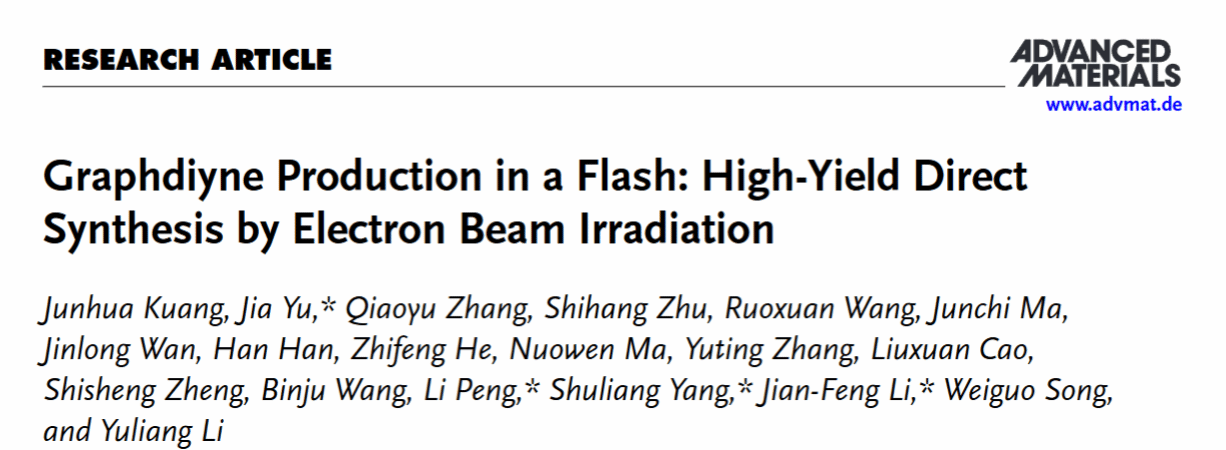
Recently, the research teams led by Professor Shuliang Yang and Assistant Professor Jia Yu from our college, in collaboration with Professor Jian-Feng Li, have made significant progress in the efficient synthesis of graphdiyne. The related work, entitled “Graphdiyne Production in a Flash: High-Yield Direct Synthesis by Electron Beam Irradiation” has been published in the top-tier international journal Advanced Materials.
In this study, the team reports a novel strategy for graphdiyne synthesis. Using a silicon-protected graphdiyne monomer, hexa[(trimethylsilyl)ethynyl]benzene (HEB-TMS), as the precursor, this method enables ultrafast and scalable GDY production under ambient conditions. Notably, it represents the fastest approach reported to date for synthesizing GDY from HEB-TMS. This unprecedented synthetic efficiency originates from the rapid in situ formation of copper acetylide intermediates, followed by electron beam-induced homolytic cleavage to generate alkynyl radicals, which subsequently undergo efficient radical coupling to form GDY.
Furthermore, this ultrafast synthesis method allows the in situ formation of uniformly dispersed Cu₂O nanoparticles on GDY, which can be directly applied to highly efficient electrocatalytic nitrate reduction to ammonia. This work provides a green, efficient, and scalable route for GDY synthesis. It significantly advances GDY preparation technologies and establishes a multifunctional platform for GDY-based catalyst design, laying a solid foundation for broader applications and industrial-scale production.
Junhua Kuang, a 2024 PhD student from our college, is the first author of this paper. Professor Shuliang Yang, Assistant Professor Jia Yu, Associate Professor Li Peng, and Professor Jian-Feng Li are the co-corresponding authors. The study also benefited from the support and guidance of Academician Yuliang Li and Professor Weiguo Song from the Institute of Chemistry, Chinese Academy of Sciences, as well as Professor Binju Wang from the College of Chemistry and Chemical Engineering at Xiamen University, Associate Professor Liuxuan Cao and Assistant Professor Shisheng Zheng from the College of Energy, Xiamen University, and Dr. Han Han from The University of Hong Kong.
This work was supported by the National Natural Science Foundation of China (T2293692, 22525042, 22021001, and 22373080), the Natural Science Foundation of Fujian Province (2022J05009, 2024J08008), the Natural Science Foundation of Xiamen City (3502Z202471009), the Fundamental Research Funds for the Central Universities (20720240054), the Nanqiang Young Scholar Program of Xiamen University, and the Xiaomi Young Talent Program/Xiaomi Foundation.
For more details, please refer to the original publication:
https://doi.org/10.1002/adma.202506979
Recommended
-

Students and Teachers of Our College Won Several Prizes in 2018 Science Innovation Competitions
-

Xiangshan College Held the Lantern Festival Party for the 98th Anniversary Celebration
-

Our college’s exchange meeting for the sharing of experience of undergraduate graduates in 2019 was held successfully
-

Enrollment propaganda in 2019 winter vacation of college of energy ended with a great success
-

The safety education conference for students in the winter vacation in 2018-2019 school year was held in our college